The same dollar works twice: it leaves the business as a deductible wage before taxes and reaches your child, normally, free of federal income tax.
Why it works
Every dollar your company spends on something ordinary and necessary lowers your taxable income. Most parents already give their children money —clothes, activities, savings— with dollars that have already been taxed.
This strategy turns that flow around. If the child does real work in the business, that money becomes a deductible wage for the company, before taxes, and reaches the child normally free of federal income tax and —in the right setup— free of payroll taxes.
It is not a trick: it is recognizing, under the IRS's own rules, that a child can be a legitimate employee.
Who it is for
- Ideal: owners of a sole proprietorship, or of a partnership where both partners are the parents (reported on Schedule C). Here the benefit is complete, including the payroll tax exemption.
- With additional structure: S-Corp or corporation owners. The payroll exemption does not apply directly; it is solved with a family management company that employs the children.
- Non-negotiable requirement: children who can do genuine, age-appropriate work — social media management, video editing, digital filing, cleaning, errands, packing.
What the law says
The wage deduction — IRC §162(a)(1). The law allows a deduction for “a reasonable allowance for salaries or other compensation for personal services actually rendered”. What matters is that it is reasonable and that the services were actually rendered. Those two conditions are what hold up the entire strategy.
The payroll exemption — IRC §3121(b)(3) and §3306(c)(5). The wages of a child under age 18 are exempt from FICA when the employer is the father or mother as a sole prop, or a partnership in which both partners are the parents. In an S-Corp, without a separate structure, that same wage would pay about $2,410 a year in FICA.
The child's tax — IRC §63. Here is the nuance many videos skip: the payment to the child is subject to income tax withholding, regardless of age. That is why the child goes on a Form W-2, never as contract labor or on a 1099. That said, every person has their own standard deduction (2025: $15,750 for a single filer, under OBBBA / P.L. 119-21), so a wage within that limit normally ends up paying $0 in federal income tax. And with that earned income the child can already open a Roth IRA.
What the court said
Eller v. Commissioner, 77 T.C. 934 (1981)
A couple paid their three children —ages 7, 11 and 12— for cleaning, errands and yard work at their mobile home park. The Tax Court allowed the wages because three things were met: the children did real work, that work would have been paid to a third party, and the parents kept a log of hours. The court did reduce the amount to what was reasonable for each child's age.
The lesson: family relationships receive heightened scrutiny. What saves the deduction is the documentation —job description, hours, actual payment—, not the intention.
How to execute it properly
- Real, age-appropriate work, with a written job description and a log of hours.
- A market-rate wage: what you would pay a stranger for that same task.
- Payment by check or transfer to a bank account in the minor's name. It leaves a trail.
- W-2 and formal payroll, not a 1099.
Three examples
- Family business on Schedule C. The 14-year-old child manages social media and edits video. A wage within the standard deduction: full deduction for the business, $0 in federal income tax for the child, and FICA exemption.
- Consultant with a single-member LLC. The same arrangement, as long as the LLC has not elected to be taxed as an S-Corp.
- Insurance agency with an S-Corp. The owner cannot put her child on the S-Corp payroll with the FICA exemption. She opens a family marketing sole prop that bills the agency for content and employs her 15-year-old to produce reels: there she recovers the exemption and keeps the deduction.
The mistake that costs you dearly
- Reporting it as contract labor or on a 1099. It is incorrect and switches off the FICA exemption. The child goes on a W-2.
- Believing the FICA exemption applies in an S-Corp. It does not: §3121(b)(3) requires the employer to be the father or mother as a sole prop or a partnership of the parents.
- Deducting the child's school, food or gas. The business deducts the wage; what the child does with their money is their own business.
- A fictitious wage with no work and no records. That is exactly what the court penalizes when there is no case like Eller behind it.
Frequently asked questions
At what age can I put my child on the payroll?
The law sets no minimum age. What the IRS requires is that the work be real and age-appropriate. In Eller v. Commissioner the Tax Court allowed wages paid to children ages 7, 11 and 12 because they did genuine work and there was a log of hours.
Does my child have to pay taxes on that wage?
The wage is subject to income tax withholding, but the child applies their own standard deduction ($15,750 for a single filer in 2025). A wage within that limit normally ends up paying $0 in federal income tax.
Can I do it if I have an S-Corp?
Yes, but not directly. The payroll tax exemption requires the employer to be the father or mother as a sole proprietorship or a partnership of the parents. With an S-Corp it is solved by employing the children through a separate family entity.
Do I give them a 1099 or a W-2?
A W-2, always. Reporting it as contract labor or on a 1099 is incorrect and switches off the FICA exemption.
Verification
✓ Legal basis verified
IRC §162(a)(1) (official text of the U.S. Code), §3121(b)(3) and §3306(c)(5), IRS Family Help, the 2025 standard deduction of $15,750 (OBBBA / P.L. 119-21) and Eller v. Commissioner, 77 T.C. 934 (1981).
Verifiable credentials




Registered tax return preparer in the IRS Annual Filing Season Program (with PTIN) · Intuit certifications in QuickBooks and bookkeeping, and Intuit training in tax preparation

“I used to feel lost with my taxes and my bookkeeping. Francisco organized everything — payroll, my books and my S-Corp structure — and I finally understand my numbers and know I'm paying what's fair, not a dollar more. He's on top of it all year, not just in April.”
Sara Salazar
Salazar Benefits Solutions LLC · ACA and Medicare insurance · Las Vegas, NV · Translated from Spanish
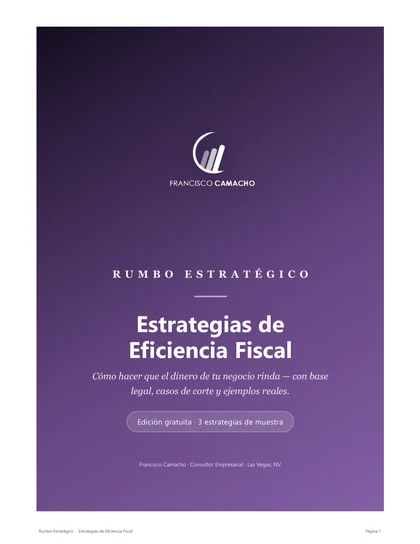
The free guide
Three complete strategies, each with its legal basis and the Tax Court case that sets the limit. Free PDF (currently available in Spanish).
Download the guideWhich of these applies to your case?
Each strategy is general. Real efficiency comes from applying it to your numbers. Book 15 minutes and you usually leave with at least one concrete finding about your money.
Book your free consultation Download the PDF guide (in Spanish)