The employee pays tax on almost everything they earn. The owner deducts real business expenses first — but it has to be a genuine business, not an excuse to deduct personal expenses.
Why it works
An employee receives a paycheck with taxes already withheld and, since 2018, cannot deduct work expenses. A business owner first deducts ordinary and necessary expenses, and pays tax only on what is left.
It is not a trick: it is how the law is designed. That is why having a business —even a side one— opens the door to tax efficiency. But it has to be a real business.
Who it is for
- Employees considering starting their own business, full-time or alongside their job.
- Owners who still “think like employees” and leave legitimate deductions on the table.
What the law says
The employee has almost no deductions, and now it is permanent. The TCJA suspended, from 2018 through 2025, the deduction for an employee's unreimbursed work expenses, and OBBBA made it permanent. A W-2 employee cannot deduct their gas, their tools or their work cell phone. Their only big deduction is the standard deduction.
The owner deducts under IRC §162. A business deducts its ordinary and necessary expenses —supplies, tools, business vehicle, cell phone, meals at 50%— before calculating taxable profit. That is the asymmetry.
The limits, so you do not fall for the myth. You do not “get down to zero” with personal expenses: only business expenses are deductible (§162), personal ones do not count (§262). And there has to be a real profit motive, or the hobby loss rule kicks in (§183).
Three examples
| Case | Income | Pays tax on |
|---|---|---|
| Joe, W-2 employee | $60,000 | ~$44,250 (standard deduction only; his work gas is not deductible) |
| Frank, business owner | $60,000 | ~$24,250, after deducting $20,000 in real business expenses |
| The mistake | — | Opening a “business” that never seeks a profit, just to deduct personal expenses: §183 knocks it down |
Same money coming in, very different tax. That is the whole idea.
The mistake that costs you dearly
- Believing you can “get down to zero” by throwing in personal expenses. Only business expenses (§162 versus §262).
- Making up a “business” with no profit motive. That is exactly what the hobby loss rule targets (§183).
- Believing crypto losses are unlimited. The cap is $3,000 a year against ordinary income (§1211).
- Thinking like an employee while being an owner. You leave legitimate deductions on the table.
Frequently asked questions
Can I deduct my work expenses if I am an employee?
No. The TCJA suspended that deduction starting in 2018 and OBBBA made it permanent. A W-2 employee cannot deduct gas, tools or a work cell phone; their only big deduction is the standard deduction.
Does having a small side business help me deduct?
Yes, as long as it is a genuine business with a profit motive. Only business expenses are deductible (§162); personal ones are not (§262). A 'business' that never seeks a profit falls under the hobby loss rule (§183).
How much can I deduct for cryptocurrency losses?
Up to $3,000 a year against ordinary income (§1211). The rest carries forward to later years. They are not unlimited.
Verification
✓ Legal basis verified
Permanent suspension of unreimbursed employee expenses (TCJA / OBBBA); IRC §162 (business deduction), §262 (personal expenses are not deductible), §183 (hobby loss) and §1211 (capital losses, $3,000-a-year cap).
Verifiable credentials




Registered tax return preparer in the IRS Annual Filing Season Program (with PTIN) · Intuit certifications in QuickBooks and bookkeeping, and Intuit training in tax preparation

“Francisco advises me on my business as if it were his own. He helped me organize how I run it and grow with direction — today I get more customers and make better decisions. For a technician focused on his work, having someone like that by your side is worth gold.”
Daniel Paredes
Frío Lagonell LLC · HVAC services · Las Vegas, NV · Translated from Spanish
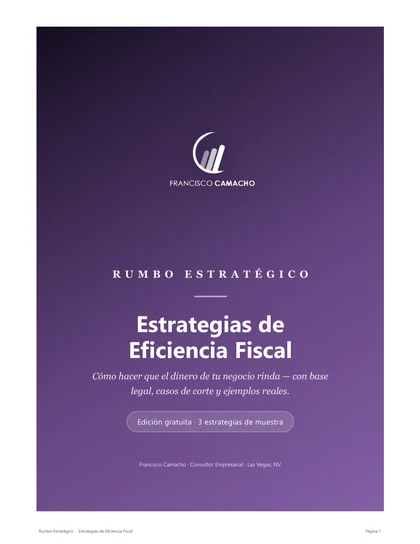
The free guide
Three complete strategies, each with its legal basis and the Tax Court case that sets the limit. Free PDF (currently available in Spanish).
Download the guideWhich of these applies to your case?
Each strategy is general. Real efficiency comes from applying it to your numbers. Book 15 minutes and you usually leave with at least one concrete finding about your money.
Book your free consultation Download the PDF guide (in Spanish)