It is one of the biggest levers available to a profitable owner. But below a certain level of profit, it costs more than it saves.
Why it works
A sole prop or a single-member LLC pays self-employment tax —15.3%— on all of its profit.
When you elect to be taxed as an S-Corp, your business pays you a reasonable salary (which does pay payroll taxes) and the rest reaches you as a distribution, which does not pay that 15.3%. The efficiency lies in splitting your income in two.
It is worth saying precisely: the S-Corp does not eliminate payroll tax. It limits it to the reasonable salary.
Who it is for
- Businesses with net profit of roughly $40,000–$50,000 and up. The threshold that matters is profit, not sales.
- Owners willing to run real payroll and file a 1120-S return.
If your profit is not there yet, the most profitable move is to wait: the cost of payroll and bookkeeping would eat up the savings.
What the law says
The self-employment tax — IRC §1401–1402. It defines the 15.3% that the owner of an unincorporated business pays on their net profit.
The election — Form 2553. It is filed to elect S-Corp treatment. If you missed the deadline, there is late-election relief under Rev. Proc. 2013-30.
Reasonable compensation. The IRS requires the owner-employee to receive reasonable compensation for their work before taking distributions. There is no single formula in the law: it is the market value of the role you perform.
What the court said
David E. Watson, P.C. v. United States (8th Circuit, 2012) and Sean McAlary Ltd., Inc. v. Commissioner (Tax Court, 2013)
These are the two cases that set the limit. In Watson, an accountant paid himself a $24,000 salary and took between $175,000 and $204,000 a year in distributions; the court accepted that his work was worth $91,044 and recharacterized the difference as wages subject to FICA. In McAlary, the sole owner of a real estate company paid himself $0 in salary and took $240,000; the Tax Court set $83,200 ($40 an hour) as reasonable compensation.
The lesson: a token salary with large distributions is the fastest way to lose the advantage — and to add FICA, penalties and interest.
How to execute it properly
- Confirm the profit justifies the cost: the FICA savings must exceed the cost of payroll, the 1120-S and bookkeeping.
- Set a reasonable salary at the market value of the role, document it, and pay it before taking distributions.
- Run real payroll: W-2, Forms 941 and timely deposits.
- File the 2553 on time, or rely on Rev. Proc. 2013-30 if you are late.
Three examples
- Consultant with $150,000 in profit. As a sole prop he would pay about $21,194 in SE tax. As an S-Corp with a reasonable salary of $60,000: FICA of about $9,180, and the $90,000 distribution pays no FICA. Gross savings close to $12,000 (about $10,000 net after costs).
- Insurance agency that is already an S-Corp. Documented reasonable salary plus distribution: the model works if the salary withstands scrutiny.
- Business with $35,000 in profit. It does not pay off yet. The cost of payroll and the 1120-S would eat up the savings. Wait until it grows.
The mistake that costs you dearly
- Saying the S-Corp “eliminates” payroll tax. It limits it to the reasonable salary.
- Setting a token salary with large distributions. Recharacterization, FICA, penalties and interest (Watson, McAlary).
- Electing S-Corp with little profit. The costs exceed the savings.
- Quoting the top marginal rate as “32%”. The individual maximum is 37%.
Frequently asked questions
At what level of profit does the S-Corp pay off?
As a reference, from about $40,000–$50,000 in annual net profit. The threshold that matters is profit, not sales: below that, the cost of payroll, the 1120-S and bookkeeping eats up the savings.
What is a reasonable salary?
It is the market value of the work you actually do in your business. There is no single formula in the law, but it must be documented and paid before taking distributions. In the McAlary case (Tax Court, 2013), an owner with a $0 salary and a $240,000 distribution ended up with a salary of $83,200 set by the court.
What happens if I missed the Form 2553 deadline?
There is late-election relief under Rev. Proc. 2013-30, as long as its requirements are met and there is reasonable cause.
Does the S-Corp eliminate payroll tax?
No. It limits it to the reasonable salary. The distribution does not pay the 15.3%, but the salary does.
Which is better for me, an LLC or an S-Corp?
They are not mutually exclusive. The LLC is the legal form of your business with the State of Nevada; the S-Corp is a way of being taxed by the IRS. An LLC can elect to be taxed as an S-Corp by filing Form 2553, without first having to file Form 8832. Whether it pays off depends on your profit: with little profit, the costs of payroll and the S-Corp return eat up the savings.
Verification
✓ Legal basis verified
IRC §1401–1402, §3121 and §199A; Form 2553, Rev. Proc. 2013-30 and IRC §7502; Form 1120-S instructions; David E. Watson, P.C. v. United States, 668 F.3d 1008 (8th Cir. 2012) and Sean McAlary Ltd., Inc. v. Commissioner, T.C. Summ. Op. 2013-62.
Verifiable credentials


Registered tax return preparer in the IRS Annual Filing Season Program (with PTIN) · Intuit certifications in QuickBooks and bookkeeping, and Intuit training in tax preparation

“I used to feel lost with my taxes and my bookkeeping. Francisco organized everything — payroll, my books and my S-Corp structure — and I finally understand my numbers and know I'm paying what's fair, not a dollar more. He's on top of it all year, not just in April.”
Sara Salazar
Salazar Benefits Solutions LLC · ACA and Medicare insurance · Las Vegas, NV · Translated from Spanish
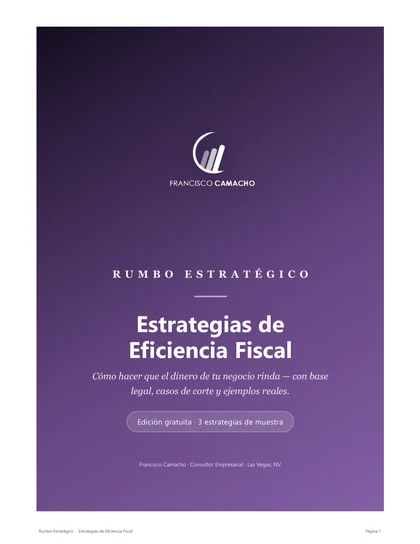
The free guide
Three complete strategies, each with its legal basis and the Tax Court case that sets the limit. Free PDF (currently available in Spanish).
Download the guideWhich of these applies to your case?
Each strategy is general. Real efficiency comes from applying it to your numbers. Book 15 minutes and you usually leave with at least one concrete finding about your money.
Book your free consultation Download the PDF guide (in Spanish)